As a free online encyclopedia, Wikipedia is the web’s most talked-about source of information.
Is It A Reliable Source Of Information?
Wikipedia is different from traditional encyclopedias in one crucial aspect. Instead of seeking out recognized authorities in hundreds or thousands of fields to write its articles, it lets anybody or more precisely everybody to write and edit them, including us.

According to Morkes and Nielsen (1997), credibility and accuracy are the most important concerns when writing for the Web. Whether intended or not, factual inaccuracies undermine the accuracy of a reference source.
The contents of Britannica are considered credible because its contributors are chosen because of their expertise in a certain field where they probably already have experience writing about their specialty in books or academic journals. Though Wikipedia does have a dedicated group of volunteer editors, it is still questioned for its misspelled words and poor grammar. No amount of volunteerism can match the motivational power of being paid, as Britannica editors are.
In order to test its reliability, a peer review of scientific entries on Wikipedia and the well-established Encyclopedia Britannica was conducted, but was not told about the source of the information. As published in the article Wikipedia survives research test by BBC News, the result of the study conducted by Nature showed that Wikipedia has 162 problems while Britannica has 123 problems, including factual errors, omissions or misleading statements.
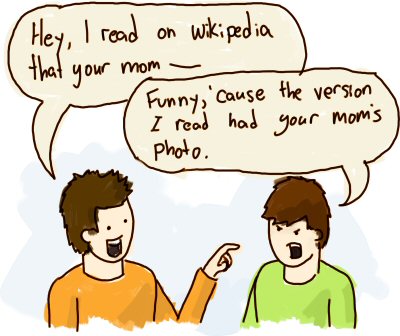
The findings of Nature reported on BBC News (2005) also indicated that Wikipedia entries were unfavorably written and poorly structured by giving false information. Wikipedia is argued to be more likely to contain an inaccurate representation of a subject added by a person intending to reduce the quality of the encyclopedia. For example, it was discovered that, a Wikipedia entry falsely claimed that the founding editorial director of USA Today was a suspect who was involved in the assassination of former US president John F Kennedy and his brother, Robert brother.
Apart from the actual content of the encyclopedias, there are also other factors involved. For example, the fact that Wikipedia articles are constantly revised and updated is an advantage because articles are more up-to-date than the annual Britannica. Ironically, it is a disadvantage because a dynamic source is often seen inappropriate to be used for research.
Wikipedia's accessibility from anywhere as long as there is access to the Internet is another benefit. Perhaps the most important is cost as Wikipedia is free, while a full print set of the most recent Britannica edition costs more than a thousand dollars.
Overall, Britannica may be a better encyclopedia than Wikipedia, but this does not mean that Wikipedia should not be used, or that it is not a valid reference source.
Although I do not solely rely on it as a source for my research, as a user of Wikipedia, I think it is essential for Wikipedia to provide accurate information and credible content for users as ‘content is the most important element of the site’ (Reep 2006, p. 174).
References:Is It A Reliable Source Of Information?
Wikipedia is different from traditional encyclopedias in one crucial aspect. Instead of seeking out recognized authorities in hundreds or thousands of fields to write its articles, it lets anybody or more precisely everybody to write and edit them, including us.

According to Morkes and Nielsen (1997), credibility and accuracy are the most important concerns when writing for the Web. Whether intended or not, factual inaccuracies undermine the accuracy of a reference source.
The contents of Britannica are considered credible because its contributors are chosen because of their expertise in a certain field where they probably already have experience writing about their specialty in books or academic journals. Though Wikipedia does have a dedicated group of volunteer editors, it is still questioned for its misspelled words and poor grammar. No amount of volunteerism can match the motivational power of being paid, as Britannica editors are.
In order to test its reliability, a peer review of scientific entries on Wikipedia and the well-established Encyclopedia Britannica was conducted, but was not told about the source of the information. As published in the article Wikipedia survives research test by BBC News, the result of the study conducted by Nature showed that Wikipedia has 162 problems while Britannica has 123 problems, including factual errors, omissions or misleading statements.
The findings of Nature reported on BBC News (2005) also indicated that Wikipedia entries were unfavorably written and poorly structured by giving false information. Wikipedia is argued to be more likely to contain an inaccurate representation of a subject added by a person intending to reduce the quality of the encyclopedia. For example, it was discovered that, a Wikipedia entry falsely claimed that the founding editorial director of USA Today was a suspect who was involved in the assassination of former US president John F Kennedy and his brother, Robert brother.
Apart from the actual content of the encyclopedias, there are also other factors involved. For example, the fact that Wikipedia articles are constantly revised and updated is an advantage because articles are more up-to-date than the annual Britannica. Ironically, it is a disadvantage because a dynamic source is often seen inappropriate to be used for research.
Wikipedia's accessibility from anywhere as long as there is access to the Internet is another benefit. Perhaps the most important is cost as Wikipedia is free, while a full print set of the most recent Britannica edition costs more than a thousand dollars.
Overall, Britannica may be a better encyclopedia than Wikipedia, but this does not mean that Wikipedia should not be used, or that it is not a valid reference source.
Although I do not solely rely on it as a source for my research, as a user of Wikipedia, I think it is essential for Wikipedia to provide accurate information and credible content for users as ‘content is the most important element of the site’ (Reep 2006, p. 174).
The State of Wikipedia
Reep, DC 2006, Technical writing: principles, strategies, and readings, 6th edn, Pearson Education, Inc., New York
BBC News 15 December 2005, ‘Wikipedia survives research test’, viewed 22 May 2011, http://news.bbc.co.uk/2/hi/technology/4530930.stm
Morkes, J & Nielsen, J 1997, ‘Concise, scannable, and objective: how to write for the web’, Useit.com, viewed 22 May 2011, http://www.useit.com/papers/webwriting/writing.html
Wikipedia, viewed 22 May, 2011, http://www.wikipedia.com
Image Source : Slap Upside The Head
Video Source : jessesaves @ YouTube

No comments:
Post a Comment