Wednesday, May 25, 2011

Celebrity Imposters on Twitter

Launched in the year 2006 by Jack Dorsey and owned and operated by Twitter Inc., Twitter is now a worldwide phenomenon, with 175 million users that have been registered as of September 14, 2010 (Twitter, 2010). It offers a social networking and microblogging service, enabling its users to send and read messages called tweets. Having tweets with a maximum character count of 140, it provide up-to-date information to users, thus creating a real-time information system that connects people worldwide (Twitter, 2010).


Twitter exploded in popularity and even celebrities are caught up with the trend, where they are allowed to be themselves, stay connected with friends, family and interact with their fans. However, there are imposters who create fake social media accounts in celebrities and some of the famous figure’s name such as the Dalai Lama, pro basketball player Shaquille O’Neal, and even teen celebrity Miley Cyrus (Owens, 2009). This has caused much confusion, as some of the tweets by the imposters were not true, while some tweets went to the extent of hurting the celebrities’ reputations.

To restore faith in the authenticity of celebrity profiles, Twitter added a Verified Accounts feature to clamp down on celebrity imposters. The move follows a lawsuit by St Louis Cardinals boss Tony La Russa over bogus tweets made in his name, as well as the creation of numerous other counterfeit celebrity profiles (Leyden, 2009).

In my opinion, although this move doesn't stop anyone creating a fake account in the first place, the reputation of celebrities will still be protected. These accounts will incorporate a seal showing that they have been verified as belonging to the person or organisation named, a posting by Stone on the Twitter blog explains.

It can prevent issues such as the case of Sanjeeda Sheikh, an Indian celebrity, who had an imposter create a new account in her name and made contact with Sheikh’s friends and family, using foul language, thus tainting Sheikh’s image (Nair, 2010).

Overall, I think that Twitter is a useful platform as it incorporates social networking with microblogging, giving users the benefit of keeping up with friends and family through their posts – tweets. It is also easily accessible via web or even mobile applications.

References:

Owens, S 2009, 'How Celebrity Imposers Hurt Twitter's Credibility', Media Shift, 20 February, viewed 25 May 2011, http://www.pbs.org/mediashift/2009/02/how-celebrity-imposters-hurt-twitters-credibility051.html

Nair, R 2010, 'Sanjeeda Sheikh Troubled by an Imposter..', viewed 25 May 2011, http://www.india-forums.com/tellybuzz/wassup/8020-sanjeeda-sheikh-troubled-by-an-imposter.htm

Leyden, J 2009, 'Twitter Fights Celeb Impostors with Verified Account Scheme', The Register, 8 June, viewed 25 May 2011, http://www.theregister.co.uk/2009/06/08/trusted_twitter/

Greenberg, A 2009, 'Top Twitter Celebrities', Forbes.com, 29 January, viewed 25 May 2011, http://www.forbes.com/2009/01/29/top-twitters-celebrities-technology-webceleb09_0129_top_twitters.html

Twitter 2010, 'About Twitter: A Few Twitter Facts', viewed 25 May 2011, http://twitter.com/about

Image Source: Boston CS

Sunday, May 22, 2011

Mobile phone advertising: the next big thing

If you thought your mobile phone was safe from the barrage of marketing messages from big advertisers, think again.

Advertising on mobile phones is primarily a new form of direct response advertising. It refers to advertisements sent to and presented on mobile devices such as mobile phones, personal digital assistants and other handheld devices. In general, advertising on mobile devices has great potential due to the very personal nature of the devices and fine-tuned targeting possibilities. Mobile advertising provides retailers with a complete and cost-effective channel through which to build customer relationships and drive sales.

With technologically advanced mobile phone services in Asia providing customers with data services such as SMS, MMS, video and mobile internet, games, downloads and mobile TV, mobile advertising can take advantage of the “third screen” (alongside the TV and the PC) to reach out to customers.

Advertising on mobile phones is primarily a new form of direct response advertising. Going beyond a more straightforward approach of inundating consumers with SMSes, more SMS-linked ads are encouraging interaction with mobile phone users, giving consumers the chance to actively respond - e.g. by answering a short quiz or expressing interest in an event to get a discount coupon via SMS.

Besides, mobile ads is also slowly seeping into the iPhone.

What is iPhone app ads?

For the most part, ads on iPhone apps seem to mimic the formats we’ve come to know via more traditional online browsing on PCs. A relatively non-intrusive banner typically shows up at the top or bottom of the open screen. They typically comprise clickable banner ads, which either link to an iPhone-optimized microsite, a Web page, or, even video, map or App Store integration.


The ads usually will be running on free iPhone apps as you can see from the example above. I personally think that's kind of crappy experience which drives many of us crazy as you have to click away from it to continue launching the app.

References:

Menayan, J 2008, "iPhone App Advertising", The YieldBuild Blog, viewed 22nd May 2011, http://blog.yieldbuild.com/2008/08/21/iphone-app-advertising/

Pfanner, E 2007, "Mobile phones are new frontier in advertising", The New York Times, viewed 22nd May 2011, http://www.nytimes.com/2007/03/11/technology/11iht-ad12.4870462.html

Reardon, M 2006, "Advertising seeps into the cell phone", CNET News, viewed 22 May 2011, http://news.cnet.com/Advertising-seeps-into-the-cell-phone/2100-1039_3-6115617.html

Image Source : Screenshot from my iPhone 4, 22 May 2011

Wikipedia vs Encyclopedia

As a free online encyclopedia, Wikipedia is the web’s most talked-about source of information.

Is It A Reliable Source Of Information?

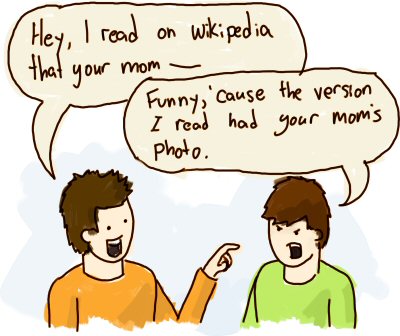
Wikipedia is different from traditional encyclopedias in one crucial aspect. Instead of seeking out recognized authorities in hundreds or thousands of fields to write its articles, it lets anybody or more precisely everybody to write and edit them, including us.


According to Morkes and Nielsen (1997), credibility and accuracy are the most important concerns when writing for the Web. Whether intended or not, factual inaccuracies undermine the accuracy of a reference source.

The contents of Britannica are considered credible because its contributors are chosen because of their expertise in a certain field where they probably already have experience writing about their specialty in books or academic journals. Though Wikipedia does have a dedicated group of volunteer editors, it is still questioned for its misspelled words and poor grammar. No amount of volunteerism can match the motivational power of being paid, as Britannica editors are.

In order to test its reliability, a peer review of scientific entries on Wikipedia and the well-established Encyclopedia Britannica was conducted, but was not told about the source of the information. As published in the article Wikipedia survives research test by BBC News, the result of the study conducted by Nature showed that Wikipedia has 162 problems while Britannica has 123 problems, including factual errors, omissions or misleading statements.

The findings of Nature reported on BBC News (2005) also indicated that Wikipedia entries were unfavorably written and poorly structured by giving false information. Wikipedia is argued to be more likely to contain an inaccurate representation of a subject added by a person intending to reduce the quality of the encyclopedia. For example, it was discovered that, a Wikipedia entry falsely claimed that the founding editorial director of USA Today was a suspect who was involved in the assassination of former US president John F Kennedy and his brother, Robert brother.

Apart from the actual content of the encyclopedias, there are also other factors involved. For example, the fact that Wikipedia articles are constantly revised and updated is an advantage because articles are more up-to-date than the annual Britannica. Ironically, it is a disadvantage because a dynamic source is often seen inappropriate to be used for research.

Wikipedia's accessibility from anywhere as long as there is access to the Internet is another benefit. Perhaps the most important is cost as Wikipedia is free, while a full print set of the most recent Britannica edition costs more than a thousand dollars.

Overall, Britannica may be a better encyclopedia than Wikipedia, but this does not mean that Wikipedia should not be used, or that it is not a valid reference source.

Although I do not solely rely on it as a source for my research, as a user of Wikipedia, I think it is essential for Wikipedia to provide accurate information and credible content for users as ‘content is the most important element of the site’ (Reep 2006, p. 174).

The State of Wikipedia


References:
Reep, DC 2006, Technical writing: principles, strategies, and readings, 6th edn, Pearson Education, Inc., New York

BBC News 15 December 2005, ‘Wikipedia survives research test’, viewed 22 May 2011, http://news.bbc.co.uk/2/hi/technology/4530930.stm


Morkes, J & Nielsen, J 1997, ‘Concise, scannable, and objective: how to write for the web’, Useit.com, viewed 22 May 2011, http://www.useit.com/papers/webwriting/writing.html

Wikipedia, viewed 22 May, 2011, http://www.wikipedia.com

Image Source : Slap Upside The Head

Video Source : jessesaves @ YouTube

Saturday, May 14, 2011

New Forms of Media Publishing

New media technologies today are radically challenging media forms. Over the past two decades we have witnessed a rapid transformation into a new form of media that has changed writing and publishing. In example, way back in the 1980s to the 1990s, news is only obtainable through print. It all first started out with the black and white printed pages and just plainly words, followed by colour texts and images.

Traditional newspapers are now available and can be read online via their website. In my opinion, the reason for many newspapers to go online is simply because the demand of Internet usage as the ease in accessibility and usability of the Internet is prominent all over the world. Now people from all over the world in different countries are able to read international newspapers daily at their convenience of reading while at work or if they are too busy to go out to get the print form of a newspaper. Accessibility to the news is now available on the Internet and even on your mobile phone.

One of the example that can seen is from Singapore's local daily newspaper, The Strait Times. Not only the traditional print version, it is also available online as well as on your mobile phone. Now there's even an iPhone app available for download at iTunes!


  Everything now is on-the-go

Apart from online newspapers, online books and online magazines a new form of media has expanded exponentially in the recent years, with websites such as Facebook, Youtube and Twitter.

During the US Election 2008, the number of videos on YouTube which are connected with US politics has increased. New media enables politicians to pick their settings, have control over their message and most importantly, get to interact with the potential voters, which is important as it makes a connection, making the voters feel like they are being approached directly (O'Hear, 2007).

New media like these are able to deliver news and information to readers faster than the traditional form of media. According to the article Twitter first to publish dramatic crash pictures published on CNN (2009), the first pictures of the Schipol airplane crash were uploaded by Twitter users. The ones who uploaded the news were just ordinary people from the online community, also known as netizens, showing that with new media, anyone can be news reporters.


All of the new media publishing has one thing in common, which is that they are all on the Internet. It makes readers better informed; giving them resources that makes them more knowledgeable on the subject.

References:

ABC Radio National, New Media Publishing, viewed 14 May 2011, http://www.abc.net.au/rn/bigidea/stories/s1485827.htm

CNN 2009, 'Twitter first to publish dramatic crash pictures', viewed 14 May 2011, http://edition.cnn.com/2009/WORLD/europe/02/25/twitter.amsterdam.plane.crash/index.html

O'Hear, S 2007, 'YouTube on the campaign trial', viewed 14 May 2011, http://www.zdnet.com/blog/social/youtube-on-the-campaign-trail/78?tag=mantle_skin;content

Image Source 1: Strait Times

Image Source 2: TechCrunch

Print Vs. Online

The way audience read online and printing is very different.

According to Kress and van Leeuwen(1998), print media focus more on its text(multimodality), with more academic based texts and structures. Prints usually play around with words as people tend to read prints more thoroughly as compared to a webpage. However, overly-structured grammar is not encouraged for online media as readers tend to scan through the text rather than actually reading (Nielsen,1997).

It is also noted that a print controls the way the information is presented to the readers. When designing print media, there is a logical sequence where we know what they've read previously, and what they're going to read next. We can write from introduction to conclusion and carefully build arguments. With chronological orders, framing, logical cues and many more to control the way the information is presented.

According Nielsen (1997), people tend to scan through a web page as compared to a print. Thus, text, colours, and titles are all very important elements into capturing the reader’s attention. Online media has to be concise, scannable and objective (Morkes & Nielsen, 1997). In designing for web, we should highlight keywords, use sub-headings, one idea per paragraph and a more concise shorter word count stating the most important information. This is because online content has no 'control' over what the audience has to read. Print content controls what the audience is reading and what they are going to read whereas online content allows the audience to be the active.

Being online makes the media experience more interactive for the consumer, something which is a barrier presented by the print medium. As there’s no place for comments, it is very difficult to interact through a print magazine. Letters to the editor are screened before they are printed; there’s no guarantee that all voices are heard. On the other hand, being online it is obviously more successful in generating discussions and feedbacks by commenting on the posts. The web also involves a greater level of interactivity due to multimedia such as images, audio and video. You can also share the article with your friends using the 'share' button via websites such as Facebook, Twitter, tumblr etc.

The information displayed online should be split into multiple hyperlinked pages so the reader can pick and choose from their preference. Serif fonts are generally easy to read and are used for lengthy paragraphs such as in print publications. Sans serif fonts however, are used more often online as it is easier to read off a brightly lit computer screen.


National Geographic 'Under Paris' Print Version


National Geographic 'Under Paris' Online Version

Above, you can see an example of both the print and online version of National Geographic's 'Under Paris' issue. Overall, the online media is concise and straight to the point, leaving lots of room for the reader to choose what they want to read. Whereas the print media leaves little space for choice and are more controlled.

References:

Nielsen, J, 1997. How Users Read on the Web, viewed 14th May 2011, http://www.useit.com/alertbox/9710a.html

Morkes, J & Nielsen, J 1997, Concise, Scannable and Objective: How To Write For The Web, Useit.com, viewed 14th May 2011, http://www.useit.com/papers/webwriting/writing.html

Kress, G & van Leeuwen, T 1998, ‘Front pages: the critical analysis of newspaper layout’, in Approaches to media discourse, eds Bell, A & Garrett, P, Blackwell, Oxford, pp. 186-219.

National Geographic, viewed  14 May 2011, http://ngm.nationalgeographic.com/

Image Source: National Geographic

Friday, May 13, 2011

Blogging Communities

Blogs creates another dimension for the society through the creation of blogging communities, which can be defined as a platform for individuals that share similar area of interests to connect and exchange ideas through the usage of blogs. A blog community can inspire ideas and developments not reached by an individual blogger (Kinkeldei, 2007). A blogging community is known as a 'blogosphere'.

According to White (2006), there are three types of blogging communities namely the Single Blog/Blogger Centric Community, the Central Connecting Topic Community and the Boundaried Community.

A blog community is a community that arises between blogs linked by a common passion or topic. For example, groups such as food bloggers, mummy bloggers, travel bloggers and political bloggers with a particular party or issue identification.

An example of a blogging community is BlogHer, where women blog and share on issues such as family, health, food and many more. The website creates opportunities for more than 25 million women who blog and their readers to gain exposure, education, community, and economic empowerment.


Another example of a blog community is Take Me Fishing, where individuals who love fishing shares photos, fishing gears, ideas and tips. Community members are able to have free access to other members' blogs and the website depends on its community input, having most of its content from members' contributions.


References : 

Kinkeldei, B. 2007 Forging Connections and Promoting Growth Through Blog Communities, 21publish.com, viewed 13th May 2011, http://www.21publish.com/pub/21publish/blogging-whitepaper.pdf

White, N 2006, 'Blogs and community - Launching a new paradigm for online community?', viewed 13th May 2011, http://kt.flexiblelearning.net.au/tkt2006/edition-11-editorial/blogs-and-community-–-launching-a-new-paradigm-for-online-community

BlogHer, viewed May 13, 2011, http://www.blogher.com

Take Me Fishing, viewed May 13, 2011, http://www.takemefishing.org/community/blog/

Classifications of blogs

Over the years, there a numerous attempts in trying to classify blogs into its respective categories. However, the constant growth of the blogosphere is making it tough to classify them specifically. With the increasing number blog posts being posted daily, there are simply no boundaries to the structure of a blog and you can really expect a wide range of topics being discussed. Each blog has their own topics, styles, formats and audience, therefore, if one were to classify each blog uniquely, there would be millions of classifications. At such, a general classification system of blogs is essential and useful for readers to search for blogs that are within their interest.

According to Farrington (2009), though there are hundreds of types of blogs online, mainly those can be classified into four types.
  • Personal blogs - Personal details, emotions, experiences, reviews irrespective of topics
  • Corporate blogs - Published by an organization to achieve its organizational goals
  • Proffesional blogs - Focus and specialize in specific subjects and fields of work
  • Micro blogs - Short texts and micro media such as audio clips and photos

On the other hand, Simons (2008) classified blogs into the following categories :
  • Pamphleteering Blog
  • Digest Blog
  • Advocacy Blog
  • Popular Mechanics Blog
  • Exhibition Blog
  • Gatewatcher Blog
  • The Diary
  • The Advertisement
  • The News Blog

By comparing both the classifications, I personally find Simons's classification of blogs to be a lot more specific than Farrington's classifications. However, I still prefer to identify blog categories through simple terms like media, news, personal, corporate, music blogs, photo blogs, video blogs etc.

References :
Farrington, R 2009, 'Different types of blogs', viewed 13th May 2011, http://www.articlemonkeys.com/Different-Types-Of-Blogs-8430.html

Funnell, A & Davies, A 2008, 'A taxonomy of blogs', viewed 13th May 2011, http://www.abc.net.au/rn/mediareport/stories/2008/2372882.htm#transcript

Simons, M 2008, Towards a taxonomy of blogs, viewed 13th May 2011, http://www.apo.org.au/commentary/towards-taxonomy-blogs-0

Saturday, May 7, 2011

Blogs As Current Phenomenon & Effects on Community

In this period of accelerating change, a phenomenon known as web logs or “blogs” for short is transforming politics, business, technology and society. A blog is somewhat an online journal for a person to express ones feelings, personal opinions, interests and some uses them to promote businesses and others. The fascinating thing about blog is one doesn't have to wait for days to their posts to be published as typically it will appear within less than an hour.

I visit several blogs almost daily because I've come to trust the insight and value the persistence of the blogger in finding the most interesting things out there. Auburn (1999) suggests what really makes the blog valuable is the combination of frequency, timeliness, and editorializing that coalesces around the blogger's voice. In short, a blog is involved in most of our lives. For that, it has become a current phenomenon.

The number of bloggers are increasing every year and this has been proven by weblog tracking site Technorati(2008). According to Technorati, which is the leading expert in the studies of blogosphere, the size of blogosphere in 2008 is a total of 133 million blog records since 2002 (Technorati 2008).


The blogging phenomenon has great potential through its power to create social cohesion and to obtain support for members of a community. One example is political blogs and the recent Singapore General Election in May 2011.

Political parties and candidates are allowed to use a broader range of new media platforms, including blogs, micro-blogs, online photo-sharing platforms, and social networking sites, for election advertising. For example, the opposition Reform Party’s (RP) secretary general Kenneth Jeyaretnam maintains a regular blog where he interacts regularly with supporters and writes posts at length on hot issues such as economic inequality hoping to translate it into actual votes.

There is also an increase number of political bloggers of all ages express their opinions in a non-confrontational manner, such as the popular Mr Brown. Having issues discussed such as the price of HDB flat, increasing rates of foreigners and other issues where majority young Singaporeans are interested in has certainly influence the society in some extent.

The community will have plenty of advantages as when reading these political blogs they can judge for themselves which party is better. Political blogs also provides useful information for the public to understand more about their country’s government.

Any open society requires and benefits from an open exchange of opinions. Blogs has brought up influence on Singaporean society although the mass media in Singapore is clearly still the biggest influence.

References:

Branum, J M 2001, The Blogging Phenomenon: An Overview and Theoretical Consideration, Southwest Texas State University, viewed 7th May 2011,  http://www.ajy.net/jmb/blogphenomenon.htm

Blood, Rebecca. Weblogs: A History and Perspective, Rebecca's Pocket,  7 September 2000. Viewed 7th May 2011, http://www.rebeccablood.net/essays/weblog_history.html

Auburn, Ben 1999, A Penny for Your 'pinion. The Atlantic Online, October 21, 1999. Viewed 7th May 2011 http://www.theatlantic.com/unbound/citation/wc991021.htm
  
Image Source: 
Technorati : State of the Blogosphere 2008

Friday, May 6, 2011

Into the Blogosphere

More than a decade ago, I was introduced to the existence of the Internet. With the emergence of the advancement of technology, information for school work is available online and a lot of things can be done just at my fingertips. I also started making news friends online and even creating personal blogs as a substitute for a diary.

This blog is created as a medium to encourage debate about media and publishing issues, inform, and educate others by applying the principles and ideas of publication and design.

As blogs can be used as a metacognitive tool to keep people think about their life or learning, I hope we can learn and most importantly exchange ideas and opinions on issues affecting media and electronic publishing and design considerations for publishing online.

Image Source : lesliestoneham